Fortæl dine venner om denne vare:
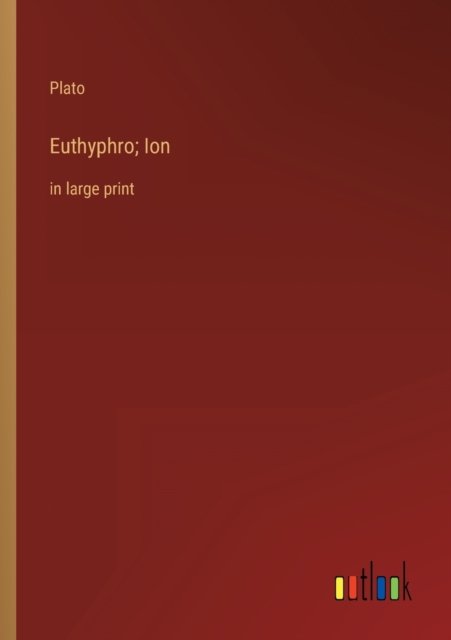
Euthyphro Plato
Bestilles fra fjernlager
 Julegaver kan byttes frem til 31. januar



Findes også som:
- Paperback Bog (2016) DKK 112
- Paperback Bog (2018) DKK 112
- Paperback Bog (2015) DKK 115
- Paperback Bog (2018) DKK 116
- Paperback Bog (2015) DKK 124
- Paperback Bog (2016) DKK 126
- Paperback Bog (2013) DKK 131
- Paperback Bog (2016) DKK 140
- Paperback Bog (2025) DKK 143
- Paperback Bog (2017) DKK 160
- Bog (2023) DKK 164
- Paperback Bog (2013) DKK 166
- Paperback Bog (2008) DKK 169
- Paperback Bog (2021) DKK 182
- Paperback Bog (2004) DKK 211
- Bog (2025) DKK 265
- Bog (2026) DKK 342
Euthyphro
Plato
The dialogue is set near the king-archon's court, where the two men encounter each other. They are both there for preliminary hearings before possible trials. Euthyphro has come to lay manslaughter charges against his father, as his father had allowed one of his workers to die exposed to the elements without proper care and attention . This worker had killed a slave belonging to the family estate on the island of Naxos; while Euthyphro's father waited to hear from the expounders of religious law about how to proceed, the worker died bound and gagged in a ditch. Socrates expresses his astonishment at the confidence of a man able to take his own father to court on such a serious charge, even when Athenian Law allows only relatives of the deceased to sue for murder . Euthyphro misses the astonishment, and merely confirms his overconfidence in his own judgment of religious/ethical matters. In an example of "Socratic irony," Socrates states that Euthyphro obviously has a clear understanding of what is pious and impious . Since Socrates himself is facing a charge of impiety, he expresses the hope to learn from Euthyphro, all the better to defend himself in his own trial. Euthyphro claims that what lies behind the charge brought against Socrates by Meletus and the other accusers is Socrates' claim that he is subjected to a daimon or divine sign which warns him of various courses of action. Even more suspicious from the viewpoint of many Athenians, Socrates expresses skeptical views on the main stories about the Greek gods, which the two men briefly discuss before plunging into the main argument. Socrates expresses reservations about such accounts which show up the gods' cruelty and inconsistency. He mentions the castration of the early sky god, Uranus, by his son Cronus, saying he finds such stories very difficult to accept. Yet after claiming to be able to tell even more amazing such stories, Euthyphro spends little time or effort defending the conventional view of the gods. Instead, he is led straight to the real task at hand, as Socrates forces him to confront his ignorance, ever pressing him for a definition of 'piety'. Yet with every definition Euthyphro proposes, Socrates very quickly finds a fatal flaw.
| Medie | Bøger Paperback Bog (Bog med blødt omslag og limet ryg) |
| Udgivet | 18. januar 2012 |
| ISBN13 | 9781469928579 |
| Forlag | CreateSpace Independent Publishing Platf |
| Antal sider | 36 |
| Mål | 2 × 152 × 229 mm · 63 g |
| Sprog | Engelsk |


![Cover for Plato · The Republic [illustrated Edition] (Paperback Bog) (2024)](https://imusic.b-cdn.net/images/item/original/405/9781434465405.jpg?plato-2024-the-republic-illustrated-edition-paperback-bog&class=scaled&v=1497212240)


![Cover for Plato · The Republic: The Essential Philosophical Dialogue (Concise Edition) - Foundations (Paperback Bog) [Concise edition] (2024)](https://imusic.b-cdn.net/images/item/original/938/9781804177938.jpg?plato-2024-the-republic-the-essential-philosophical-dialogue-concise-edition-foundations-paperback-bog&class=scaled&v=1695111621)