
Fortæl dine venner om denne vare:
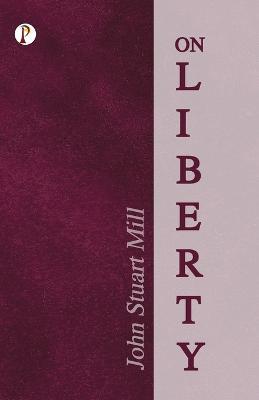
On Liberty (annotated) John Stuart Mill


Findes også som:
- Paperback Bog (2018) DKK 89
- Paperback Bog (2018) DKK 117
- Paperback Bog (2015) DKK 117
- Paperback Bog (2018) DKK 117
- Paperback Bog (1982) DKK 118
- Paperback Bog (1986) DKK 119
- Paperback Bog (2014) DKK 120
- Paperback Bog (2011) DKK 124
- Paperback Bog (2017) DKK 124
- Paperback Bog (2015) DKK 124
- Paperback Bog (2018) DKK 124
- Paperback Bog (2015) DKK 124
- Paperback Bog (2017) DKK 127
- Paperback Bog (2017) DKK 127
- Paperback Bog (2017) DKK 131
- Paperback Bog (2013) DKK 131
- Paperback Bog (2021) DKK 132
- Paperback Bog (2026) DKK 133
- Paperback Bog (2018) DKK 139
- Paperback Bog (2017) DKK 139
- Paperback Bog (2017) DKK 139
- Paperback Bog (2012) DKK 139
- Paperback Bog (2011) DKK 145
- Paperback Bog (2011) DKK 146
- Paperback Bog (2013) DKK 146
On Liberty (annotated)
John Stuart Mill
On Liberty by John Stuart Mill is a political science classic and one of history's most important political works. Mill declares that "over himself, over his own body and mind, the individual is sovereign". If you are interested in political philosophy - this is a must read!On Liberty was a greatly influential and well received work, although it did not go without criticism. Some attacked it for its apparent discontinuity with Utilitarianism, while others criticized its vagueness. The ideas presented in On Liberty have remained the basis of much liberal political thought. It has remained in print continuously since its initial publication. To this day, a copy of On Liberty is passed to the president of the British Liberal Democrats as a symbol of office. A copy of the same book is also presented to and then held by the president of the Liberal Party as a symbol of office. Mill's marriage to his wife Harriet Taylor Mill greatly influenced the concepts in On Liberty, which was largely finished prior to her death, and published shortly after she diedJohn Stuart Mill opens his essay by discussing the historical "struggle between authority and liberty,"[6] describing the tyranny of government, which, in his view, needs to be controlled by the liberty of the citizens. He divides this control of authority into two mechanisms: necessary rights belonging to citizens, and the "establishment of constitutional checks by which the consent of the community, or of a body of some sort, supposed to represent its interests, was made a necessary condition to some of the more important acts of the governing power."[7] Because society was-in its early stages-subjected to such turbulent conditions (i.e. small population and constant war), it was forced to accept rule "by a master."[7] However, as mankind progressed, it became conceivable for the people to rule themselves. Mill admits that this new form of society seemed immune to tyranny because "there was no fear of tyrannizing over self."[8] Despite the high hopes of the Enlightenment, Mill argues that the democratic ideals were not as easily met as expected. First, even in democracy, the rulers were not always the same sort of people as the ruled.[9] Second, there is a risk of a "tyranny of the majority" in which the many oppress the few who, according to democratic ideals, have just as much a right to pursue their legitimate ends.[9][10][11]In Mill's view, tyranny of the majority is worse than tyranny of government because it is not limited to a political function. Where one can be protected from a tyrant, it is much harder to be protected "against the tyranny of the prevailing opinion and feeling."[10] The prevailing opinions within society will be the basis of all rules of conduct within society; thus there can be no safeguard in law against the tyranny of the majority. Mill's proof goes as follows: the majority opinion may not be the correct opinion. The only justification for a person's preference for a particular moral belief is that it is that person's preference. On a particular issue, people will align themselves either for or against that issue; the side of greatest volume will prevail, but is not necessarily correct.[12] In conclusion to this analysis of past governments, Mill proposes a single standard for which a person's liberty may be restricted: That the only purpose for which power can be rightfully exercised over any member of a civilized community, against his will, is to prevent harm to others. His own good, either physical or moral, is not a sufficient warrant ... Over himself, over his body and mind, the individual is sovereign
| Medie | Bøger Paperback Bog (Bog med blødt omslag og limet ryg) |
| Udgivet | 19. november 2015 |
| ISBN13 | 9781519382719 |
| Forlag | Createspace Independent Publishing Platf |
| Antal sider | 132 |
| Mål | 152 × 229 × 7 mm · 185 g |
| Sprog | Engelsk |







![Cover for John Stuart Mill · Essais Sur La Religion, (Ed.1875) (French Edition) (Paperback Bog) [French edition] (2022)](https://imusic.b-cdn.net/images/item/original/448/9782012661448.jpg?john-stuart-mill-2022-essais-sur-la-religion-ed-1875-french-edition-paperback-bog&class=scaled&v=1409647394)
![Cover for John Stuart Mill · Le Gouvernement Representatif (3e Ed.) (Ed.1877) (French Edition) (Paperback Bog) [French edition] (2022)](https://imusic.b-cdn.net/images/item/original/847/9782012686847.jpg?john-stuart-mill-2022-le-gouvernement-representatif-3e-ed-ed-1877-french-edition-paperback-bog&class=scaled&v=1410237929)


